The risk register is not where you start. It is where you end up, once you know what the firm actually does.
Traditional GRC
Approach
-
Risk register, built in a workshop
-
Controls mapped to risks afterward
-
Attestation chased from reluctant operators
-
Reports built on reluctant, late data
Disengaged Business Teams
Controls-First
Approach
-
Controls drawn from real work
-
Risks emerge from controls in use
-
Attestation owned by accountable operators
-
Reports built on live, current view of the work
Engaged Business Teams
The inversion
The risk register is not the starting point. It is the consequence.
Every traditional GRC deployment starts in the same place: a risk register, built in a workshop, by people who have not yet looked at what the firm actually operates. Controls get mapped to it afterward. The first line is then asked to attest against a document they had no hand in building.
The Controls-First Approach inverts that sequence. Inventory the controls first. Assign ownership. Establish attestation cycles. Track actions, map lessons learnt, risks, and indicators follow from the operational picture, not from a prior assumption about what the risks should be. The register emerges based on operational reality.
Traditional GRC starts with a risk register built in a workshop, with controls mapped to it afterward and the first line asked to attest against a document they had no hand in building.
The Controls-First Approach inverts that sequence: inventory the controls first and let risks, lessons, and indicators follow from the operational picture.
Maturity journey
Same start. Many paths.
Four stages run in sequence. The modules and branches that activate within each stage depend on the firm's regulatory context, not on a fixed rollout schedule. A Lloyd's coverholder and a principal firm running ARs reach the same four stages by different routes.
The framework is the same. The path through it is theirs.
what the board sees
Every line in the board report traces back to operational reality.
The Controls-First Approach produces a board view that traces back to operational reality. Not to a workshop output. The three things that make it possible are below.
Controls and Actions
The work evidences itself.
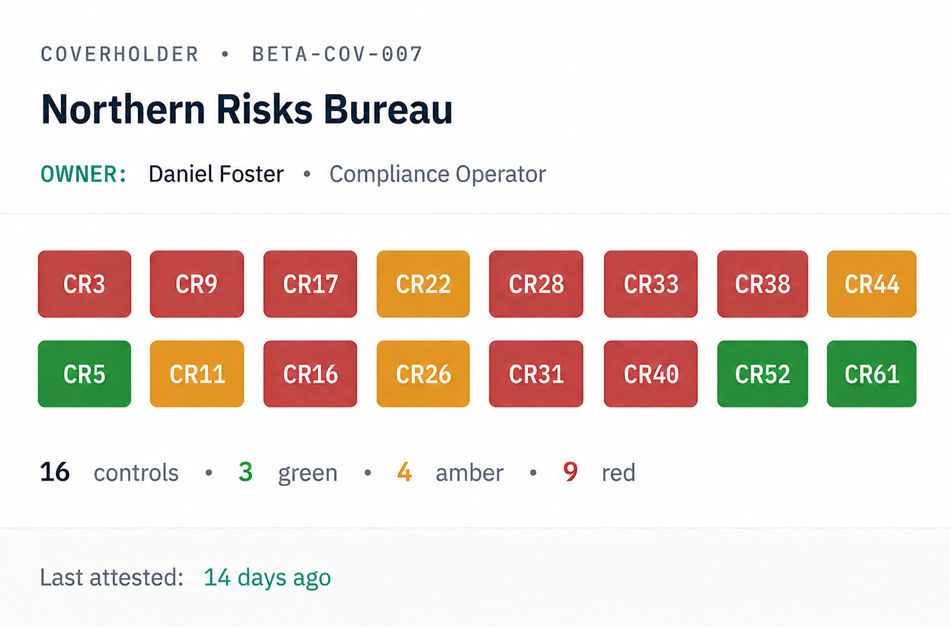
Each control in has an owner, an attestation cycle, and an evidence record. Actions track what needs fixing and when it was fixed. The Board sees live control status, not a quarterly snapshot someone assembled from five spreadsheets.
Lessons learnt
Problems do not repeat.
Risk Incidents and Complaints feed lessons back into the controls that govern the work. The Board sees not just what went wrong, but what changed as a result. That is what a closed governance loop looks like in a board paper.
Risks and Indicators
Risks from operations.
Risks and Indicators attach to the controls and processes already in the platform. The risk register does not float free of the operational picture. It is a view on it. The Board sees a risk register populated by the work the firm actually does.
"CoVi has become our primary internal governance and monitoring tool. The system helps us stay in sync with a challenging and constantly evolving regulatory environment, centralising evidence for our risk and compliance framework."
IN Production
Pro MGA Solutions
Head of Compliance
IN PRODCUTION
54 Agents. One firm. One Controls-First Approach.
A UK principal firm running 54 Appointed Representatives deployed the Controls-First Approach across the full network. Controls were inventoried and owned first. Risk Incidents captured what went wrong. Simplified onboarding and on-going monitoring.
The firm's Head of Compliance describes what changed. The platform is now their primary internal governance and monitoring tool.
Read the case study.
From quarterly snapshots to live evidence. In weeks.
Controls-first Methodology
Built on the work, not on workshops.
The Controls-First Approach starts with what the firm actually operates: the controls, the owners, the evidence. Three stages take that operational picture all the way to what the Board sees. No register pre-built from a workshop. No gap between the work and the report.
Built by an operator who has seen these challenges from the auditor's and the regulator's perspective. In production at a UK principal firm running 54 Appointed Representatives.