


RiskOps for Managing Agents
Every coverholder, in context.
Every quarter, evidenced.
Live oversight of every coverholder relationship, with Lloyd's Principles-Based Oversight (PBO) grade evidence already in place before the audit asks for it. For Heads of Delegated Authority where quarterly attestation has become its own workstream.
Built by an operator who has seen these challenges from the auditor's and the regulator's perspective. In production at a UK principal firm running 54 Appointed Representatives.
Relevance
The gap, in delegated-authority terms.
Six questions the Head of DA cannot answer cleanly today. Each one is a consequence of the same structural gap: a quarterly snapshot where Lloyd's now wants live evidence.
If you own delegated authority oversight
"Our coverholder file is forty PDFs and a tab in a spreadsheet."
CONSEQUENCE
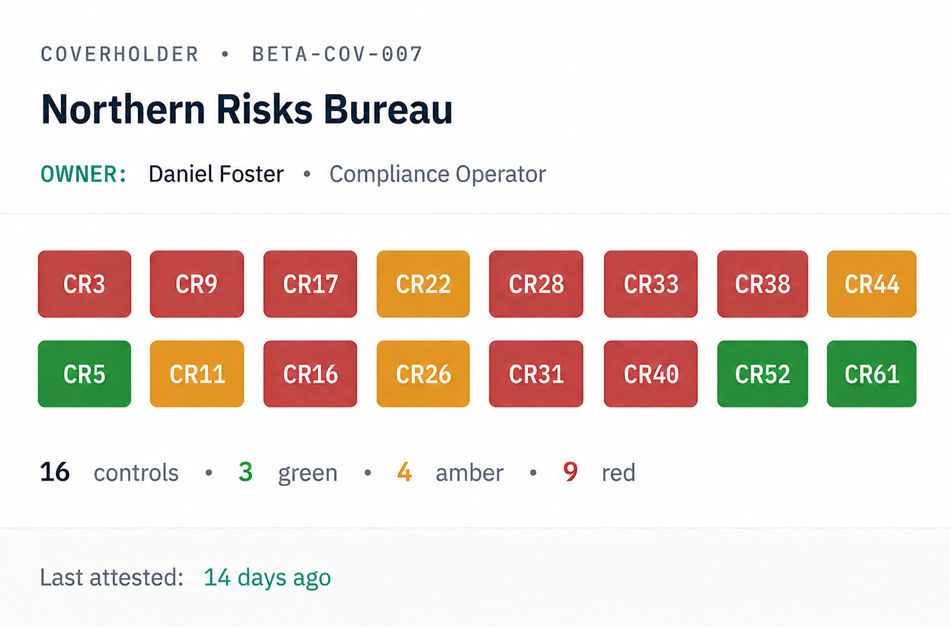
The artefacts exist. The picture does not. No single surface shows control performance at the coverholder level, control by control, on demand.
If you run the coverholder programme
"The quarterly cycle eats my team for four weeks. Then we start the next one."
CONSEQUENCE
Two to four people spend five to fifteen working days per cycle chasing late returns, parsing inconsistent attestation formats, and assembling a pack that is already a quarter old when it lands.
If you run the coverholder programme
"If Lloyd's asked us tomorrow how our coverholders are actually behaving against the agreed framework, the real answer is a quarterly snapshot."
CONSEQUENCE
The framework is agreed at binder. The behaviour against it is reconstructed after the fact from email self-attestations. Lloyd's is moving away from accepting that reconstruction as evidence.
If you own delegated authority oversight
"Three of our coverholders are always late. We know which three. We chase them every cycle."
CONSEQUENCE
The structural late-returners are visible to the team but invisible to the framework. Nothing escalates them automatically. Nothing records that the chase pattern has been the same for six cycles.
If you sit on the managing agent's board
"When the COO asks for a current-state RAG view by end of day, the DA team opens Excel and starts collating."
Two hours of work each time, and the result is already a quarter old when it lands. The board cannot run oversight on a view that has to be rebuilt from scratch every time it is requested.
CONSEQUENCE
If you run the coverholder programme
"The DA portals we have looked at are workflow tools. They do not evidence control performance."
The market sells you a portal for the binder lifecycle. It does not give you a live, evidenced view of how the coverholder performs against the control framework. Different problem, different surface.
CONSEQUENCE
THE INVErSION
Start with the work. The evidence falls out.
GRC starts with risks. The Controls-First Approach starts with controls. For coverholder oversight, that single inversion is the difference between a pack the regulator believes and a pack no one trusts.
CONTROLS-First
Approach
-
Live view of coverholder control performance, refreshed each time evidence is filed
-
Attestation chase collapses to an exception list. Hours per cycle, not days
-
Each incident sharpens the control; the new instruction reaches every coverholder running it
-
Late-return patterns escalate inside the framework, on a path the board can see
-
The COO, the board, and Lloyd's open the same live view directly. No rebuild required
Proactive Coverholder Oversight
CHASE-first
Approach
-
Quarterly snapshot assembled from email and spreadsheets, a quarter old when it lands
-
Five to fifteen person-days per cycle on the attestation chase
-
Incident lessons stay in the log; the instruction to the coverholder never changes.
-
Structural late-returners chased manually, no escalation path in the framework
-
Every COO, board, or Lloyd's request triggers hours of rebuilding the coverholder view from scratch.
Reactive Coverholder Oversight
the architecture
One control. Many coverholders. A framework that learns.
Every coverholder control is set centrally as a parent, rolled out as child instances, and updated across the network the moment a lesson lands. Six steps, walked through below.
the regulatory moment
Why 2026, not 2024 or 2027.
Lloyd's Principles-Based Oversight
Lloyd's introduced PBO in the 2024 to 2025 cycle, replacing prescriptive minimum standards with a principles-based regime. Managing agents are categorised by maturity tier. Delegated authority oversight is one of the principles assessed. A weak DA evidence position downgrades the agent across every other dimension Lloyd's reviews.
Converging supervisory standards
The FCA's three-year AR oversight programme concluded in 2024 to 2025 with hard findings. Coverholder oversight at Lloyd's managing agents sits in the same supervisory frame, even where the FCA is not the direct supervisor. The regulators talk to each other. The standards and expectations converge across FCA and Lloyd's.
Volatile market conditions
Insurance rates are softening across multiple lines after the 2021 to 2023 hard market. Expense ratios are under board scrutiny. Compliance and operations salary inflation has made hiring out of the problem unaffordable for most firms in this band. The real CFO conversation is: produce the evidence with what you have, not with more.
Soft market, more mis-selling temptation, regulators want managing agents watching their coverholders harder. A live control framework is the lowest-cost route to a defensible answer.
what the board sees
Every line in the board report traces back to operational reality.
The Head of DA produces the evidence. The board reads what it produced. Lloyd's reviews what the board read. Three audiences, one operating layer.
Controls and Actions
Structured instruction where work evidences itself.
Each attestation, each exception, each piece of evidence files against the named control it tests, on the coverholder it relates to. The picture assembles as the work happens. There is no separate collation step before the board pack.
Lessons learnt
Every incident strengthens the operating posture.
When an incident lands at one coverholder, the control sharpens for all of them. The revised instruction reaches every coverholder running that control on the next cycle. One coverholder's lesson becomes the operating standard for the book.
Reporting and Audit
The audit trail exists by construction.
When Lloyd's asks for evidence of coverholder oversight, the trail is already there. Date-stamped, attributed, linked to the named control. No reconstruction from email threads and spreadsheet histories.
IN Production
"CoVi has become our primary internal governance and monitoring tool. The system helps us stay in sync with a challenging and constantly evolving regulatory environment, centralising evidence for our risk and compliance framework."
Pro MGA Solutions
Head of Compliance
IN PRODUCTION
54 Agents. One firm. One Controls-First Approach.
A UK principal firm running 54 Appointed Representatives deployed the Controls-First Approach across the full network. Controls were inventoried and owned first. Risk Incidents captured what went wrong. Simplified onboarding and on-going monitoring.
The firm's Head of Compliance describes what changed. The platform is now their primary internal governance and monitoring tool.
Read the case study.
Differentiation
Three comparisons the Head of DA will make. All three answered.
Against email, spreadsheets, and colour codes
The team that runs coverholder oversight on email, spreadsheets, and a colour code is not under-equipped. It is over-equipped with the wrong shape of equipment. Each artefact is fit for one moment in the cycle. None is fit for the question Lloyd's now asks: show me, live, how this coverholder is behaving against the agreed framework, control by control.
A live control framework answers that question by construction. Attestations, exception logs, and evidence packs all get filed against the named control they relate to, on the coverholder they relate to. The picture assembles itself as the work happens.
Against the DA portal pattern
DA portals are workflow tools for the binder lifecycle. They handle the contract, the bordereaux, the regulatory submission. They do not maintain a live view of how the coverholder performs against the control framework, because that is not what they were built for.
Coverholder oversight at PBO standard is a control framework problem. The framework sits alongside the DA portal, not in place of it. If your firm already runs a portal, the framework feeds off the same evidence and gives the Head of DA the live view the portal does not produce.
Against the GRC pattern
GRC tools are built for the second-line reviewer, populated by the first-line operator, and the first line does not use them. That is the structural failure of the category. The result is a tool the risk team owns and the operations team avoids, with real work continuing in email and spreadsheets next to the tool that was meant to replace them.
Context Visualised is the decision center for regulated firms. The Head of DA and the DA team are the buyers and the people who open it every day. The risk team gets the evidence layer they need, because the operating team produces it on a tool they actually open. RiskOps is GRC seen from the side of the people who do the work.