core · the operating layer
Built for the people taking the risk.
The operator sees the why, not just the what. Controls, risks, indicators, and incidents land in one view, so a sign-off is an informed call. The board report traces back to operational reality, in real time.
The op risk platform for the first line.

Built by an operator who has seen these challenges from the auditor's and the regulator's perspective. In production at a UK principal firm running 54 Appointed Representatives.
the structural difference
The question is not which GRC platform. It is who it was built for.
Traditional GRC tools extract data from the first line to serve the second line. CORE is built the other way round. The difference is structural, not cosmetic.
Controls-First
OpRisk Plaform
-
Built for operational teams to manage the work they are already doing
-
First line uses CORE because it makes their own work clearer
-
Compliance evidence falls out as a byproduct
-
One control inventory: the operational reality and the regulatory record
-
Risk register follows from the controls already in place
Engaged first line
TRAditional
GRC Platforms
-
Built for risk and compliance teams to report on the first line
-
First line fills in forms to feed the second line's reports
-
Compliance evidence is the primary product
-
Operational controls run in parallel on spreadsheets and runbooks
-
Risk register precedes the operational control picture
Disengaged first line
INSIDE CORE
Designed for the doer’s daily view, not the reviewer’s quarterly report.
Every feature in CORE follows from a single design rule: the operator is the user. Three features carry the rule most visibly.

01
One screen carries the control, its owner, the risks it protects against, the indicators feeding it, the actions in flight, and the incidents that have hit it. The operator no longer fills in a form disconnected from purpose. The work becomes informed.
The contextualised cards
See the why, not just the what.

02
Every operational update carries the evidence and the rationale supporting it. Past assessments are available at a click, with the preparer's reasoning and the reviewer's call in view. The audit trail is built as the work is done, not reconstructed when someone asks.
Evidence-backed updates
Five to seven clicks. Not twenty fields.
03
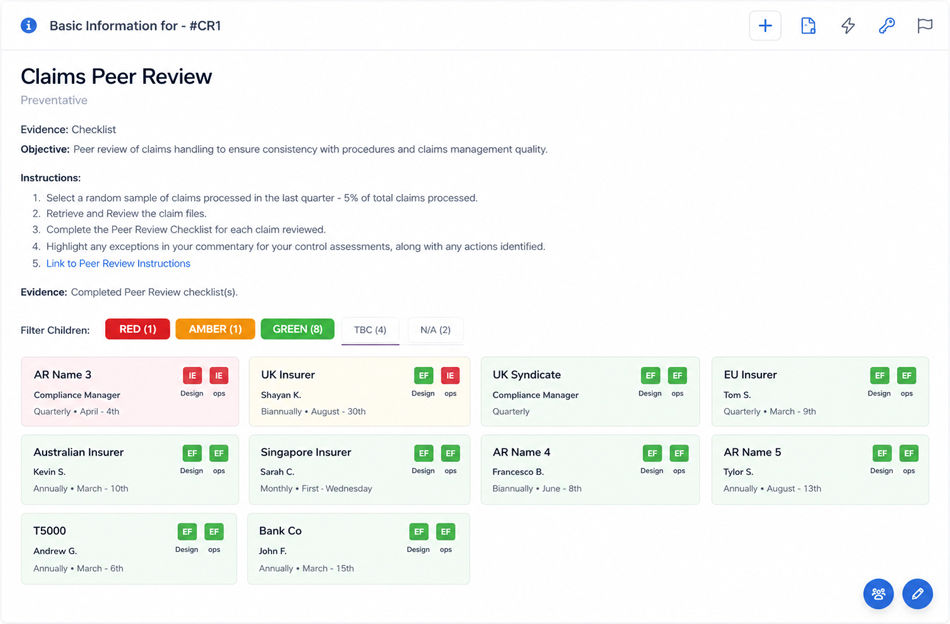
Define the framework (e.g. Controls and Risks) once at the parent. Every child entity adopts it, deviations are visible, and reporting rolls up to one consistent view. The compliance teams that used to spend weeks reconciling spreadsheets across entities get those weeks back.
Parent-Child rollout
Define once. Consistent rollout & reporting.
delivering context
Every view carries its context. Every failure surfaces where it matters.
Open the view for any risk, control, policy, or process and the context is already there. Add a control, log an incident, or mark a status. Every related view picks up the change in real time. Nothing needs stitching together when someone asks. It is already there.
business outcomes
One operating layer. Three views that finally agree.
When the operating layer is the same layer the second line reports from and the board reviews, the three views of the firm stop contradicting each other.
for the first line
Doing it twice stops being the job.
Clear instructions. No duplication.
The operator no longer has to work out what the compliance function wants. Every view carries the instructions, the context, and the evidence required. The work itself produces the evidence the second line needs. The first line stops running a parallel compliance exercise.
for the second line
Data quality stops being the job.
Live data. Real oversight.
The CRO and the Head of Compliance no longer have to chase first-line inputs for data they cannot trust. Incidents surface in real time against the controls and risks they relate to. The second line stops chasing inputs and starts interpreting a live picture of the firm's risk posture.
for the board
Curated reports stop being the job.
Verify the work. Not the summary.
The board no longer has to take the management summary on trust. INEDs drill into the live record and ask informed challenge questions. Named accountability under SM&CR matches the person actually doing the work. The board moves from receiving assurance to verifying it.